Monday, 2 June 2014

TRACKING THELMA MOSIER THROUGH THE YEARS

When 72 year old Dr Robert Henry MacLauchlan was arrested for drug trafficking following a raid, jointly undertaken by the RCMP Drug Squad and the New Westminster Police (with what might be called background assistance from the Vancouver Police), on Wednesday, December 22, 1965, three other people were arrested – Margaret Anne Cunningham 50, Joe Sperling 45 and Thelma Mosier 40. MacLauchlan, Cunningham and Sperling had their preliminary hearing in New Westminster. 
On the other hand, Thelma Mosier, who was nowhere in sight when the initial takedown occurred, was arraigned in Burnaby. We have mentioned this before. We are also wondering how she came to be involved in this crime and have recently come across some possible leads. In any case, in March 1966, Thelma Mosier pleaded guilty and was sentenced to seven years. 
We have done some research into Mrs Mosier and have come up with the following information: we are certain she was married to Richard Mosier, born in 1914, who died in 1984. The Mosiers first appear together in the public record in 1953, in the federal voting list for that year, when they are living on Fell Avenue in Burnaby and, again in 1957, in the federal voting list, when they are living in Half Moon Bay, near Nanaimo, on Vancouver Island. In the 1953 list Richard Mosier is listed as a truck driver and, in the 1957 one, as a logger. In the 1953 electoral roll, the Mosiers are listed as living at the same address on Fell Avenue as a Mr and Mrs L Bullerwell. It appears that the couple separated at some point after that because, by the time of the 1965 voters list, only Thelma Mosier appears. She appears at a Sperling Avenue address, the same one as William and Hazel Boone, a married couple in which the husband is a sales analyst. Mrs Boone has no occupation listed. 
Remembering that Mrs Mosier was arrested in 1965 and sentenced to seven years on March 3, 1966, it is not surprising that, when her husband Richard next appears in a voters list, it is by himself – in Sechelt in the 1968 and 1972 lists. On both occasions he is listed as a logger. Richard Mosier died aged 70 on June 21, 1984 in Vancouver.
However, Thelma Mosier pops up next in a rather interesting situation. It seems reasonable to assume that the woman who, from 1982 until 1992, was listed as the Manager at the Seventh Step Society at 219 Carnarvon Street in New Westminster was the same person as the associate of Dr MacLauchlan, Margaret Anne Cunningham and Joseph Sperling. After all, the everyday management of the Seventh Step was run by ex-convicts. Probably for that reason, the organization was, during the 1970s in New Westminster, a very controversial establishment. Based on the teachings of Bill Sands and Rev. James Post, Seventh Step was basically composed of ex-convicts, who had gone “straight” and become successful citizens, helping newly paroled prisoners follow the same path of reform and re-entry into society. Incidentally, one of the directors of the organization at that time was Provincial Court Judge Nick Mussallem.
The current Seventh Step Society website states the following credo:

7th Step is a program designed to help the incorrigible and recidivist offender change their behavior and attitudes using a basic self help philosophy.  Its fundamental principles are realistic thinking and positive peer pressure.

In the history of penology there has never been a program, which could conclusively reach and motivate to change the hard-core convict population.  The Seventh Step, self-help program was initially designed to reach those men and women who are many time losers.  They are strong men and women who often are leaders within the structured institutional environment.

So, basically it was about ex-convicts helping newly-released convicts rebuild their lives along the straight and narrow. At the time of its introduction to New Westminster, many citizens wanted nothing to do with it. The Seventh Step Society first came to public attention in New Westminster with its plans to establish a half-way house for prisoners at 131 Third Street in the Queen’s Park neighbourhood. Hundreds of angry Queen’s Park residents put their names to a petition opposed to the idea and presented it to City Council. Similarly the prospect of a convict (ex or not) settlement at 219 Carnarvon also ran into a storm of opposition – especially from business owners along that street. However, that particular hostel seems to have weathered the outrage because it operated in that location at least until 1990. By the time Thelma Mosier was manager at Seventh Step at 219 Carnarvon in 1982, it appears the organization had become an accepted part of the neighbourhood landscape.
Ken and I would be most interested in hearing from anyone who knew Mrs Mosier when she was the manager at Seventh Step and can share their impressions or anecdotes about her.

Saturday, 24 May 2014

NICK MUSSALLEM A SUCCESS IN LAW BUT NOT IN POLITICS

Following their arrests on December 22, 1965 for trafficking about $200,000 worth of narcotics (worth about $10 million in today’s currency) from their modest 5th Street bungalow in New Westminster, Dr Robert Henry MacLauchlan, Margaret Anne Cunningham and Joseph Sperling faced the specially appointed Crown Prosecutor, Wilfred Heffernan in a bail hearing. (The fourth person arrested in the case, Burnaby waitress Thelma Mosier, was arraigned in Burnaby). Of course any trial has two sides making arguments to the judge and jury, and the three people standing in the dock two days before the Christmas of 1965 were no exception. Of the two lawyers defending MacLauchlan and his associates, one was Raymond James Westaway, whose practice dealt usually with civil, as opposed to criminal, matters. 
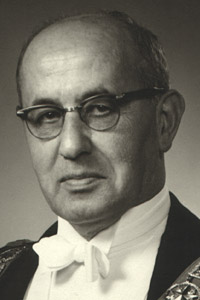
The MacLauchlan group’s other lawyer, as has been briefly mentioned here before, was Nick Mussallem (younger brother of former Social Credit MLA George Mussallem of Maple Ridge and son of a long time Haney mayor, Solomon Mussallem.).
Of Lebanese descent Nick Mussallem no doubt had a significant reputation as a barrister. For example, about a decade previous to defending MacLauchlan, Cunningham and Sperling at the preliminary hearing, Nick Mussallem had played a role in two other very high-profile judicial situations during the 1950s – first the Tupper Inquiry into corruption in the Vancouver City Police when Chief Walter Mulligan was investigated for taking bribes, and, second, the several-year judicial proceedings (a public inquiry and a trial) against Social Credit Forests Minister Robert Sommers during the mid-1950s when Sommers, along with several other men, was implicated in a bribe-taking scandal.
Regarding the Sommers trial, which was presided over by Chief Justice J. O. Wilson, Mussallem acted at some points in the trial in concert with another well known British Columbia jurist, East Vancouver-born Angelo Branca, one of the city’s best known criminal lawyers, who later went on to sit on the BC Supreme Court. One of Mussallem’s successes in the early part of the process was to get permission for Sommers to sit in the Legislature while the preliminary hearing (run by Magistrate Oscar Orr) was underway. It is unlikely that such a situation would prevail today – an MLA facing serious criminal charges being allowed to take his seat in the Legislature.
Like his brother George, Nick Mussallem had political ambitions. However, his were less successful. When he ran for the Liberal Party in the riding of Vancouver Burrard in the provincial election of 1963 both he and his NDP opponent, Tom Berger, (who, as mentioned above, defended Sperling after the MacLauchlans had been murdered) were defeated by Social Credit Party candidates. (Vancouver Burrard was a two-member riding). Nick Mussallem was appointed to the BC Provincial Court in July 1971.
As usual Ken and I are seeking information from anyone who may have had personal knowledge of Nick Mussallem. We understand he had a son and we are hoping that son may recall anecdotes of his father’s cases and give us some details about the MacLauchlan case. But we need to find the son first. Any assistance in this search will be greatly appreciated.


Thursday, 1 May 2014

LT COLONEL DONALD GEORGE MACLAUCHLAN – MORE A MARTINET THAN A NATURAL LEADER?

Even martinets have their sensitive side. That certainly seems to have been the case with Lt Colonel Donald George MacLauchlan, commanding officer of the Calgary Highlanders who was Dr Robert Henry MacLauchlan’s younger (and more respectable) brother. Succeeding Lt Col Fred Scott in February 1942 when the regiment was in England undergoing further military training, MacLauchlan was a different kind of man. In the early part of his command, when the Highlanders were following closely upon the initial successes of the hard fought D-Day landings, he was regarded by the troops as being squeamish about being under fire.

According to sources quoted by well-known University of Calgary history professor David Bercuson in his 1994 book “Battalion of Heroes: The Calgary Highlanders in World War II”, MacLauchlan was not often seen in the front lines leading the troops. Rather, he preferred to be in his bunker doing paperwork and reports or interviewing underlings. However, by the end of his tenure as Commanding Officer (CO), MacLauchlan had gained significantly in self-confidence as a leader and had faced fire along with his men. As well, he was well-regarded when it came to organizing and undertaking set-piece engagements.

According to Bercuson and an earlier chronicler of the Highlanders, Terry Copp, battle fatigue did the regiment’s second CO in. Not insensitive, MacLauchlan was still not one to indulge in camaraderie with his fellow officers. “Remote” probably was the word that best describes his leadership style. At the same time, however, the same authors mention that MacLauchlan did suffer quite personally over the officers and men under his command when they suffered injury or death. In fact, on one of the last days of his command, Lt Col Donald George MacLauchlan did break down over the fact that he was departing from his fellow officers.

He was succeeded as CO by Lt Col Ross Ellis, a man very much admired by the men under his command – probably since they knew he had risen through the ranks to lead the regiment. Unlike MacLauchlan he never, even from the first, displayed a reluctance to be in the front lines with his troops, facing the same dangers as them.

As we have mentioned before in this blog, Ken McIntosh and I are very interested to find out if Lt Col MacLauchlan and his wartime bride, Elizabeth Loder Johnson (the daughter of Baroness Selsdon, a lower echelon member of the British Aristocracy), had any children. If that is the case, we might be able to contact them in order to find out more about their uncle, Dr Robert Henry MacLauchlan. After all, the doctor along with his third wife (and fellow murder victim) Margaret Anne, remains the focus of our research.
We can be contacted through the home page of this website.
The above photo and its accompanying caption is taken from Prof. Bercuson's 1994 book on the Calgary Highlanders, which is mentioned above.

Sunday, 16 March 2014

MISSION IMPOSSIBLE NUMBER 2? SEEKING LETHBRIDGE JAIL EX-PRISONERS OR EX- STAFF WHO MAY HAVE KNOWN DR ROBERT HENRY MACLAUCHLAN

Upon his conviction for procuring abortions in early January 1955, Dr Robert Henry MacLauchlan served his one year term in Lethbridge Provincial Jail (at that time called Lethbridge Provincial Gaol). It is likely he would have served only about eight months before he was released. Upon his release he came to British Columbia and, as we have reported before, by 1955 he was receiving his mail at 660 Howe Street in Vancouver but living with Margaret Anne “Nan” Cunningham at 912 5th Street in New Westminster.

We have noticed that people in Canada, USA, Germany, South Korea, Russia, Brazil, Australia, Czech Republic, France and Indonesia have been following our progress. The greatest numbers have come from Canada. It would be great if some of those Canadians are from Alberta – especially from Lethbridge!

Now – and this may be a second Mission Impossible! – we are wondering if we have any Lethbridge readers with some connection to the Lethbridge penal institution. Perhaps they are former guards, families of former guards or other corrections staff. Maybe they are even former prisoners or offspring of former prisoners. In any case, we would like to hear from anyone who has some knowledge – even second or third hand – of MacLauchlan when he was imprisoned.   

If at all possible, we want to know all sides of this rather enigmatic man. We would welcome stories or comments, and all submissions will remain confidential unless the sender desires otherwise. Please use our contact information on the home page of this website.

Thursday, 13 March 2014

MISSION IMPOSSIBLE? SEEKING ABORTION PATIENTS OF DR ROBERT HENRY MACLAUCHLAN

Following his arrest in Calgary on October 16, 1954, along with his associates druggist John Dixon and two women, Mrs. Anne Gregor, and Audrey Ekiss, Dr Robert Henry MacLauchlan’s preliminary hearing took place November 1, 2 and 4, 1954 before Magistrate Royal Verne Read. All were charged with conspiring to procure an abortion. The case went before the Alberta Superior Court in mid-January 1955: MacLauchlan got one year in jail plus a $2500 fine; Dixon received a $2500 fine plus one day; the two women, Anne Gregor and Audrey Ekiss received $1000 and one day each.
MacLauchlan served his time in Lethbridge Provincial Jail. Upon his release he came to British Columbia and, as we have reported before, by 1955 he was receiving his mail at 660 Howe Street in Vancouver but living with Margaret Anne “Nan” Cunningham at 912 5th Street in New Westminster. Police at the time suspected he might have been performing abortions in Vancouver. In our search for more information on both MacLauchlan and Cunningham (who later became MacLauchlan’s wife following their arrest for trafficking in narcotics in December 1965), we have received a few tips from New Westminster residents (including former neighbours) and elsewhere.
Now – and this may be Mission Impossible given the very nature of the procedures and the length of time that has elapsed since they were carried out – we would like to hear from some of MacLauchlan’s former patients. 
Although it is hard to quantify the numbers before abortion became legal in Canada in the early 1970s, speaking very approximately the abortion rate since then has tended on average, to be about 15 per 1000 for women aged 15-44. (Source Abortion statistics and other data--Johnston`s Archive at http://www.johnstonsarchive.net/policy/abortion/ab-canada.html). 
However, given the social and religious stigmas attaching to abortion previous to its legalization, it may be possible to safely assume that the rate was perhaps only 1/10 of that figure before the early 1970s. Some calculations are in order: The female population of Canada in 1951 aged 15 to 44 was 22% of the total population. The Alberta population was 940,000 in 1951. If the age and gender breakdown of the Albertan population was similar to that of the Canadian population as a whole, this means that there were approximately 207,000 women aged 15 to 44 in Alberta. Taking Johnston’s ratio (that the abortion rate was 15 per thousand) and plugging it into 207,000 gives us 3100 abortions in Alberta in the early 1970s.
If we return to our starting point -- that abortion rates (i.e. illegal abortions – the only kind possible during MacLauchlan’s era of operation) were 1/10 of the early 1970s figure -- then that may mean there were about 300 abortions annually in Alberta in the 1950s. Since the Pecover sisters have told the authors that every week there were a few girls (let us assume two or three) sneaking up to MacLauchlan’s house, this would put his potential abortion total at about 100 per year. 
The point of all this calculation is to suggest that there may have been a sufficient number of abortions performed in the 1950s in Alberta that there are women still living who were among those seeking that service from MacLauchlan. However, even if that is not the case, there may still be other people – i.e. husbands, fathers, boyfriends, mothers, brothers, sisters – who are aware of these women and their situations. There may be family memories of such events.
And here’s the kicker: we would like to hear of such stories. Not for the names but more for what their teller may remember of Dr MacLauchlan himself – or have heard tell of him. Remember: our valued correspondent, Albertan author Jack Pecover, who knew MacLauchlan personally (though not well), says the consensus of Calgary neighbourhood opinion was that the doctor was fulfilling a valuable community service. If at all possible, we want to know all sides of this rather enigmatic man. We would welcome stories or comments, and all submissions will remain confidential unless the sender desires otherwise. Please use our contact information on the home page of this website.

Saturday, 8 March 2014

DR ROBERT MACLAUCHLAN VIA LT COL DONALD G MACLAUCHLAN: KNOWING A MAN THROUGH HIS BROTHER?

One of the most memorable lines in the famous movie Dr Zhivago is spoken by the title character’s half-brother, a Bolshevik policeman.

“I’ve always thought,” he says with a somewhat cynical smirk, “If you want to get enough on a man to arrest him, interview his brother.” That’s not the exact speech but it’s close enough for our purposes in our never-ending search to find out more information on Dr Robert Henry MacLauchlan, convicted Calgary abortionist from the 1950s and 1966 murder victim of a Mafia-linked Vancouver drug organization.

We have just found a book of about 300 pages, of which a good one-quarter have information on MacLauchlan’s younger brother, Lt Colonel Donald George MacLauchlan. Professor David Bercusson, long associated with the University of Calgary and a respected historian of Canada’s military, wrote a 1994 book called Battalion of Heroes: The Calgary Highlanders in World War II. Lt Colonel MacLauchlan, who won the DSO for some brilliant tactics during the 1944 Normandy campaign, commanded the Highlanders for much of that period.

Battalion of Heroes has much information on the military MacLauchlan and we fully expect to cultivate it to gain further sources relevant to his older – and somewhat less respectable – medical brother by a close perusal of these sources. Readers, stay tuned!

Wednesday, 5 March 2014

DREAMING OF DOGS AND DR MACLAUCHLAN

Few subjects interest me as much as Dr Robert Henry MacLauchlan, his life and his murder. Another topic of interest to me is that of dreams. Several mornings ago these two primary fascinations came together when I had the following dream:

I have some trouble getting on a bus because there are two guys standing in the doorway. Irritated by this obstruction, I look at them angrily and yell, “Why the Hell do you people insist on standing in the doorway?” and grab them, throwing them out of the bus. The driver is surprised and says, “Hey, you can’t do that!” Ignoring him, I go nearly to the back of the bus and sit down opposite a tall fellow with brown hair who is wearing a blue T-shirt. On his lap, he is also holding an animal carrying case in which he has a small dog. Striking up a conversation with me he says, “You know that doctor with all the dogs, the guy you’re writing about? Well, he bought a lot of land.”

Now, aside from the fact, that I am definitely not in the habit of throwing people out of buses and have never done so, the dream does refer to the research that my colleague Ken McIntosh and I have done on Dr MacLauchlan (and each of his three wives). One of the things we have learned about him is that he seemed fond of dogs. In the case of his second and third wives, Evelyn Hambly and Margaret Anne Cunningham, respectively, he always had at least one canine around.

We have noted this before but, in light of the above dream, it is worth repeating: In the several years before his death (along with Margaret Anne) on March 21, 1966, his habit of walking Pogo, a small dachshund, was often noted by his Fifth Street neighbours. Intriguing always to Ken and me, within the whole story of the MacLauchlan Murders, is Pogo’s behavior during and after the murders. The little Dachshund, regular readers of this blog will recall, must have been in the house when Dr Robert Henry and Margaret Anne MacLauchlan were shot to death. Yet no one heard the dog bark around the time of the murder.

Is it reasonable that Pogo would not have barked? A little research on the Internet among websites dedicated to dogs in general and Dachshunds in particular confirms indeed that the breed is very “yappy.” Press reports of Pogo’s behavior on March 22nd (the day after the murder) indicate that the dog was out on the sidewalk in front of 912 Fifth Street – you guessed it -- yapping. However we have covered that conundrum before and have concluded that Pogo knew the MacLauchlans’ murderer. In turn that indicates that the MacLauchlans knew their murderer – or at least one of them did.

The dream figure’s concluding comment, “You know that doctor with all the dogs, the guy you’re writing about? Well, he bought a lot of land,” raises the question of whether MacLauchlan might have in fact been reinvesting his money from his role in the drug trade. Remember, when he and Margaret Anne were arrested and charged with trafficking in narcotics on December 22, 1965, he was found to have $200,000 worth of heroin in his possession at a time when houses in New Westminster were selling for between $8700 and $12,700.

If the doctor was investing his ill-gotten gains in land and that land was in the Vancouver area, where might it have been located? This is one of the avenues we are looking into at present. More information may be forthcoming. Visit this site often to keep updated.